WHAT ARE HORMONES?
Hormones are your body’s chemical messengers. They’re produced by a gland, carried by the blood, which alters the activity of specific target organs and is then destroyed by the liver. They travel in your bloodstream to tissues or organs. They work slowly, over time, and affect many different processes, including:
• Growth and development
• Metabolism – how your body gets energy from the foods you eat
• Sexual function
• Reproduction
• Mood
Hormones of Thyroid
Thyroid gland basically releases two hormones Triiodothyronine and Thyroxine ,which helps in controlling the metabolism of our body. Further, these hormones regulate weight, determines energy levels, internal body temperature, skin, hair etc.
Insuline
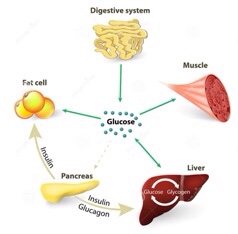
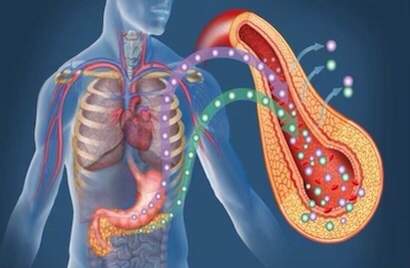
This hormone is released by the pancreas, a leaf-like gland located in the abdominal cavity behind the stomach. It allows the body to use glucose or sugar from carbohydrates in the food for energy or to store glucose for future use. It helps in keeping blood sugar level from getting too high i.e. hyperglycemia or too low i.e. hypoglycemia.
Estrogen
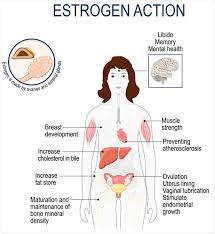
It is a female sex hormone released by the ovaries. It is responsible for the reproduction, menstruation and menopause. Excess of estrogen in the female body increases the risk of breast cancer, uterine cancer, depression, moodiness etc. If the estrogen level is less in female body then it leads to acne, skin lesions, thinning skin, hair loss etc.
Adrenaline
Adrenaline is produced in a “fight or flight” situation when you are scared or excited, your body produces adrenaline. Adrenaline is secreted by the adrenal glands (there is one above each kidney) and is released into the blood so that it can travel to the appropriate target organs.
Adrenaline stimulates the heart to beat faster the pulse rate increases. This means more blood (and thus, more oxygen) can be pumped around the body. It also stimulates the concentration of blood vessels in the skin and digestive system, so more blood is pumped to the muscles and the brain. This means they can respire faster, providing more energy to run or fight.

Endocrine glands
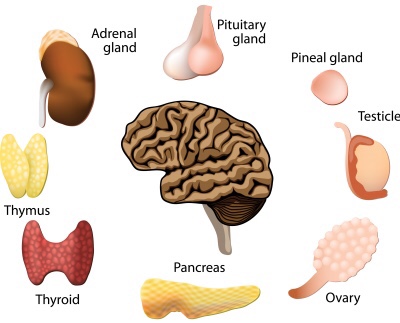
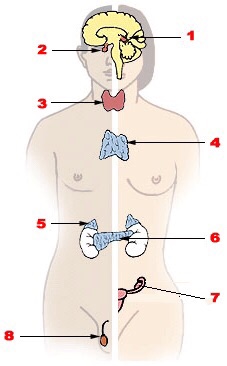
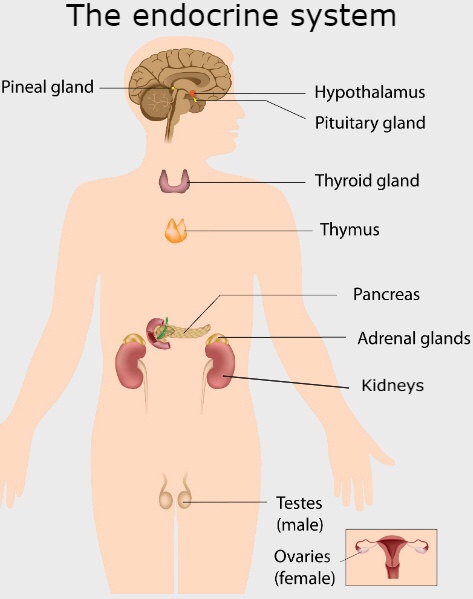
Endocrine glands, which are special groups of cells, make hormones. The major endocrine glands are the pituitary, pineal, thymus, thyroid, adrenal glands, and pancreas. In addition, men produce hormones in their testes and women produce them in their ovaries.
Hormones are powerful. It takes only a tiny amount to cause big changes in cells or even your whole body. That is why too much or too little of a certain hormone can be serious. Laboratory tests can measure the hormone levels in your blood, urine, or saliva. Your health care provider may perform these tests if you have symptoms of a hormone disorder. Home pregnancy tests are similar – they test for pregnancy hormones in your urine.
The endocrine system
The endocrine system is made up of the endocrine glands that secrete hormones. Although there are eight major endocrine glands scattered throughout the body, they are still considered to be one system because they have similar functions, similar mechanisms of influence, and many important interrelationships.
Some glands also have non-endocrine regions that have functions other than hormone secretion. For example, the pancreas has a major exocrine portion that secretes digestive enzymes and an endocrine portion that secretes hormones. The ovaries and testes secrete hormones and also produce the ova and sperm. Some organs, such as the stomach, intestines, and heart, produce hormones, but their primary function is not hormone secretion.
Paracrine System
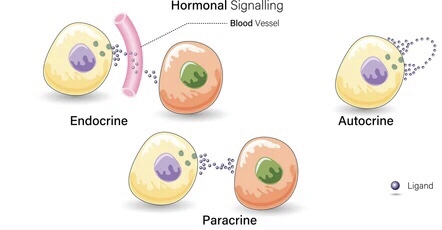
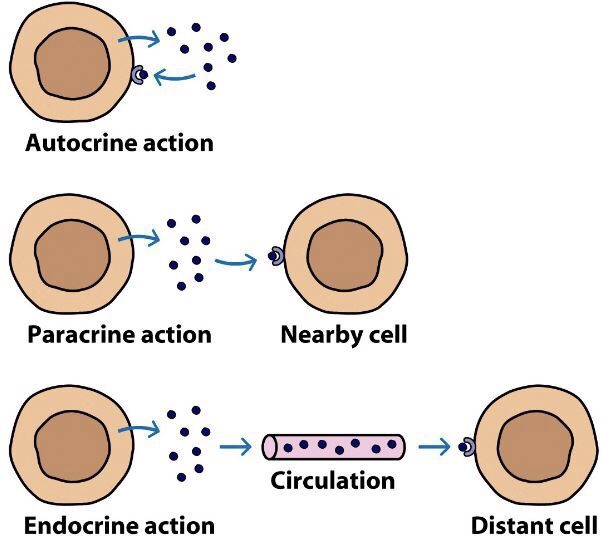
The hormone acts locally by diffusing from his source to target cells nearby. In paracrine signaling, the molecules released by a cell only affect target cells in close proximity. Paracrine communication is a method of communication between cells that causes desired changes in surrounding cells and chemically altering the behavior surrounding cells. It allows healing a wound or repairing neurogenesis for medical conditions.
Autocrine System
Autocrine signaling is a form of cell signaling in which a cell secretes a hormone or chemical messenger (called the autocrine agent) that binds to autocrine receptors on that same cell, leading to changes in the cell. Tumor development is a complex process that requires cell division , growth, and survival. One approach used by tumors to upregulate growth and survival is through autocrine production of growth and survival factors. Autocrine signaling plays critical roles in cancer activation and also in providing self-sustaining growth signals to tumors.
A cura di: Antonelli Giulia, De Angelis Giulia, Esposito Alessandra, Pezzuto Giorgia, Pisaniello Claudia, Polisi Marta e Russo Margherita.
 Hormones